
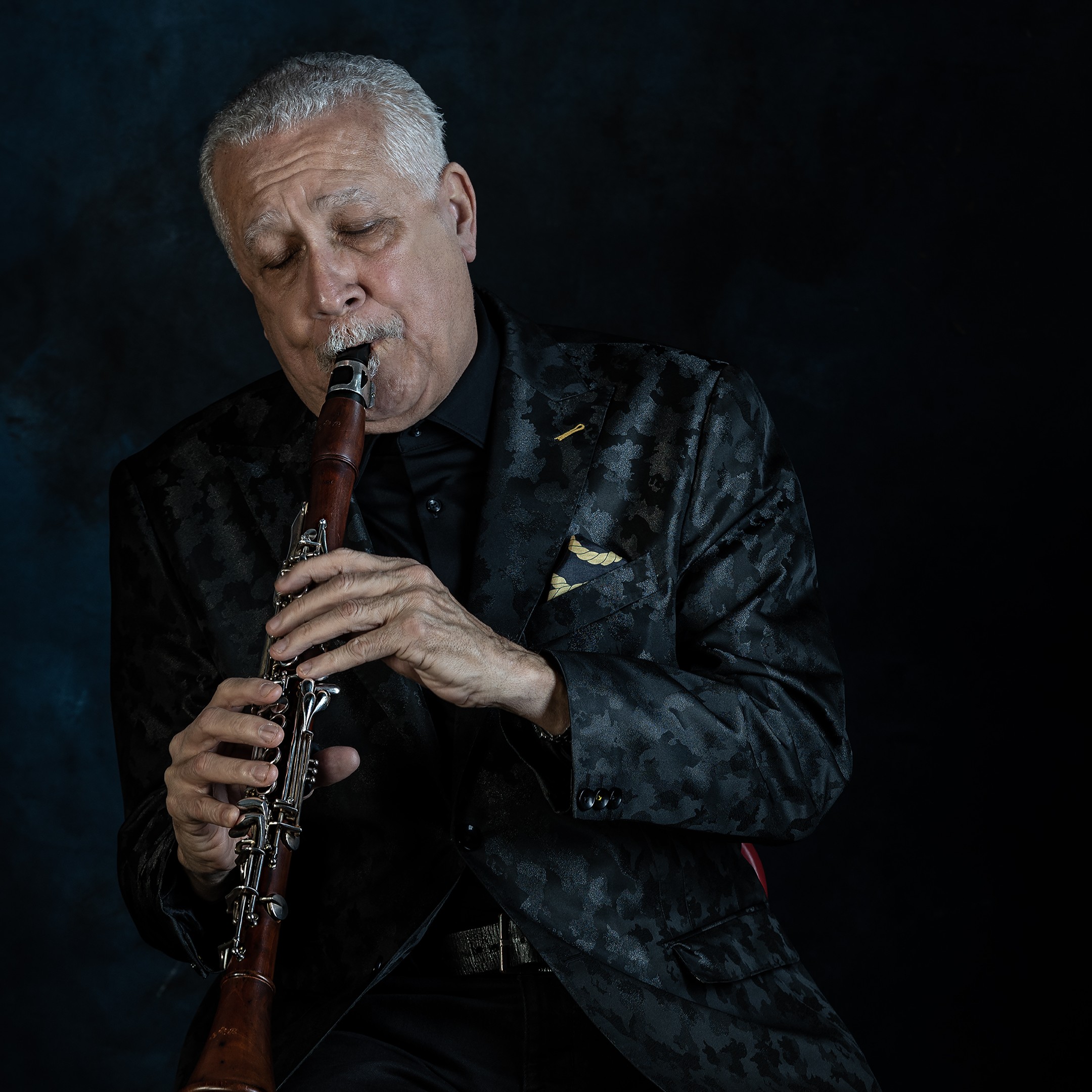
One of the greatest living jazz musicians of all time, clarinetist, saxophonist, composer, arranger, and educator Paquito D'Rivera (also known as “El Paq-Man”) will perform at this year’s Nišville Jazz Festival with his trio. During his remarkable career, Paquito D’Rivera has won as many as sixteen prestigious Grammy Awards in different categories. He is the only artist ever to have won Grammy Awards in both classical music and Latin jazz categories. Joining him at Nišville will be Pepe Rivero on piano and Sebastián Laverde on vibraphone and marimba.
Paquito D’Rivera was born in Marianao, Havana, Cuba, in 1948. His father, Tito, was a classical saxophonist, so Paquito began taking music lessons at the age of five, and by the age of seven he was already performing across Cuba as a child prodigy. At ten, Paquito performed accompanied by the National Theatre Orchestra of Cuba and studied at the Alejandro G. Caturla Conservatory in Marianao. At seventeen, he became one of the founders of the Cuban Orchestra of Modern Music, and frequently played clarinet and saxophone with the Cuban National Symphony Orchestra, performing works by prominent Cuban and international composers. For two years, D’Rivera also conducted the Cuban Orchestra of Modern Music.
Together with pianist Chucho Valdés and percussionist Oscar Valdés, he co-founded the now legendary Latin jazz ensemble Irakere, later joined by trumpeter Arturo Sandoval. Irakere is considered one of the most important and innovative groups to pioneer the fusion of jazz, rock, classical, and traditional Cuban music. In 1977, Irakere performed at the Belgrade Jazz Festival and Jazz Jamboree, where they shared the stage with Betty Carter and the Thad Jones/Mel Lewis Orchestra. By then, their albums had already received several Grammy nominations. Since moving to the United States in 1980, Paquito D’Rivera has released more than forty solo albums and performed and recorded with many jazz legends as well as major philharmonic orchestras in the field of classical music. In 1988, D’Rivera became one of the founders of the United Nation Orchestra, a fifteen-member band organized by Dizzy Gillespie to present a fusion of Latin and Caribbean influences with jazz. The United Nation Orchestra — whose leadership D’Rivera assumed after Gillespie’s death — won a Grammy Award in 1991, the same year D’Rivera was honored at Carnegie Hall for his contribution to Latin music.
Since moving to the United States in 1980, Paquito D’Rivera has released more than forty solo albums and performed and recorded with many jazz legends as well as major philharmonic orchestras in the field of classical music. In 1988, D’Rivera became one of the founders of the United Nation Orchestra, a fifteen-member band organized by Dizzy Gillespie to present a fusion of Latin and Caribbean influences with jazz. The United Nation Orchestra — whose leadership D’Rivera assumed after Gillespie’s death — won a Grammy Award in 1991, the same year D’Rivera was honored at Carnegie Hall for his contribution to Latin music.
That same year, several jazz legends — Dizzy Gillespie, Stan Getz, and Earl Hines — embarked on a “jazz cruise” to Cuba to explore the island’s music “at the source.” In Havana, Irakere had the opportunity to jam with Gillespie and Getz, marking the first time since the breakdown of relations between the United States and Cuba that musicians from the two countries were able to perform together. Likely thanks to those connections, Irakere appeared the following year at two editions of the Newport Jazz Festival (in New York and Rhode Island), as well as the renowned Montreux Jazz Festival. Some recordings from those performances were released by Columbia Records, and the album Irakere won a Grammy Award in the Latin category after several previous nominations.
He has also received numerous honors for his contribution to music, including honorary doctorates from major universities, and has written several books infused with his characteristic sense of humor — something he regularly brings not only to his concert performances and stage introductions, but also to the music itself.
Escape into (Musical) Freedom
By 1980, D’Rivera had grown dissatisfied with the restrictions imposed for years on the music he performed in Cuba. In an interview for Reason TV, D’Rivera recalled that the Cuban communist government described jazz and rock and roll as “imperialist” music, discouraged throughout the 1960s and 1970s, though still tolerated. In early 1980, while on tour in Spain, he sought asylum at the American embassy, leaving behind his wife, child, and brother Enrique — also a saxophonist — in Cuba, with a promise that he would eventually bring them to freedom as well. He was only able to fulfill that promise nine years later. Incidentally, Arturo Sandoval also emigrated to the United States the following year (1981), but having learned from his bandmate’s experience, he managed to bring his immediate family out of Cuba as well. The entire operation — which reportedly involved intelligence services — became the subject of the 2000 feature film For Love or Country: The Arturo Sandoval Story, in which Sandoval was portrayed by Andy García and Paquito by José Zúñiga.